Loading...
Lest We Forget, part 6: Building Memory: The Memorials of 1920 and 1921
Within two years of the Armistice, Harpenden, Wheathampstead and St Albans each raised a permanent memorial, and the same man unveiled all three.
Part 6 of 13 of Lest We Forget, a history of remembrance in Harpenden and St Albans. Read the whole illustrated book.
Within two years of the Armistice, Harpenden, Wheathampstead and St Albans each raised a permanent memorial, and the same man unveiled all three. Lieutenant General the Earl of Cavan, Commander-in-Chief at Aldershot, opened the Harpenden cross on 9 October 1920, the Wheathampstead cross on 31 October 1920 and the St Albans memorial in May 1921.
- Harpenden, Church Green — Unveiled: 9 October 1920 (the town's history society also records a dedication on 20 October) · Designer and maker: Ernest Hasseldine, with architect Stanley Salisbury · Funding and extras: Public subscription; site about £900
- St Albans, St Peter's Street — Unveiled: 22 May 1921 (some sources say 21 May) · Designer and maker: Edgar Wigram, with mason Charles Alderton · Funding and extras: Memorial garden laid around it in 1921
Harpenden: a cross raised by subscription
Planning for the Harpenden memorial began in early 1919. A Memorial Cross Committee gathered the town's wishes and asked a local artist, Ernest Hasseldine, to design the cross. Hasseldine, who had moved to Harpenden for his health and later designed the original Harpenden sign on the Common, drew on Celtic crosses from Scotland, Wales and Cornwall. He travelled to Cornwall with the architect Stanley Salisbury to choose the granite.
A high proportion of the town contributed to the fund by local subscription. Part of the money paid for the cross, and part went to buy and equip a Nursing Centre at 40 Luton Road, so that the memorial would help the living as well as honour the dead. The cross stands on Church Green, on a three-stepped base with a rough-hewn plinth and bronze plaques on its sides. Its front inscription is dedicated to the glorious memory of the men of Harpenden who fought and died in the Great War. The back reads: erected by the people of Harpenden in gratitude, love and pride.
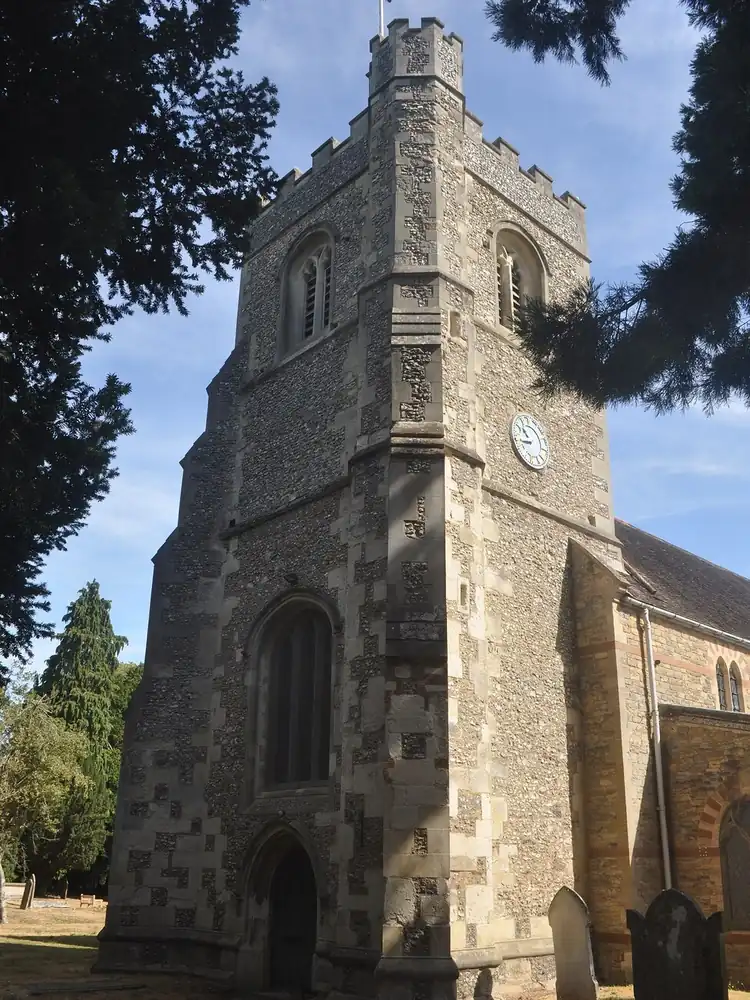
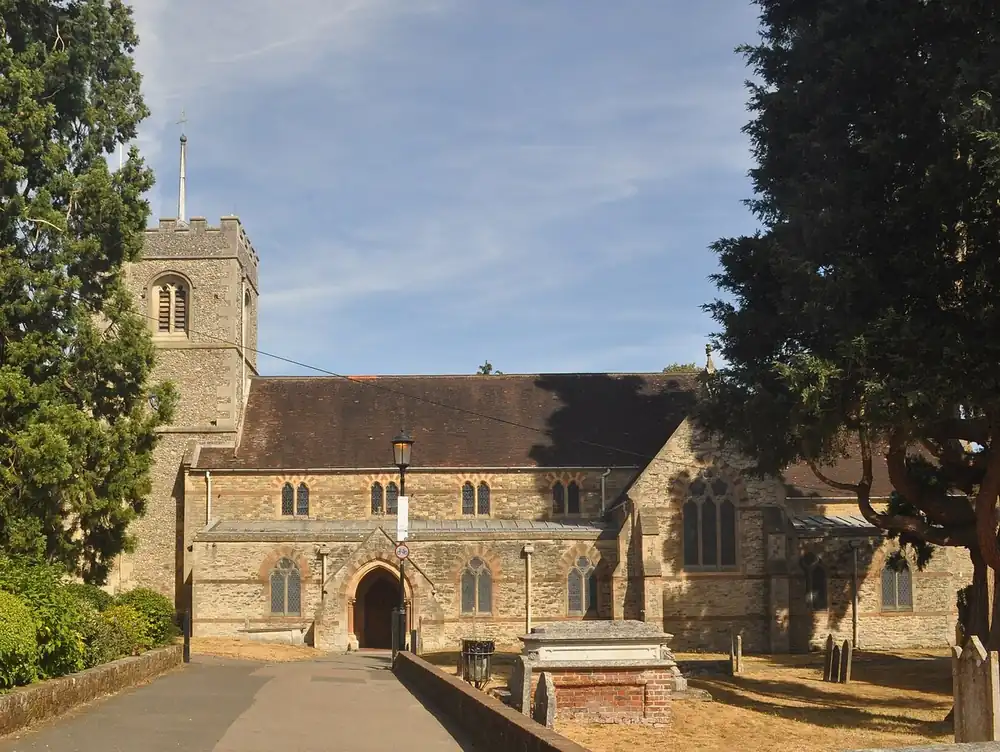
Two views of St Nicholas' Church, Harpenden. The town's war memorial is on Church Green nearby.
Photos: Hassocks5489, CC0.
The cross was not the first memorial in town. A shrine at the bottom of Cravells Road, to the men of South Harpenden, was dedicated on 19 July 1919. The town's memorial is now Grade II listed, was cleaned and repointed in 2009, and is looked after by Harpenden Town Council. On 11 November 2020, a century after its dedication, it was floodlit in red.
Wheathampstead and Gustard Wood
The neighbouring village of Wheathampstead followed within weeks. After a request for a faculty in April 1920, its memorial was erected quickly and dedicated on Sunday 31 October 1920 at 3pm, with a large body of villagers present. The Earl of Cavan addressed ex-servicemen at the station, a procession formed, and the cost was about £400. In March 1921 he unveiled a smaller tablet at St Peter's Church in Gustard Wood. Some men who lived in the area appear on more than one memorial, including Harpenden's.
St Albans: a cross by the city's future mayor
The St Albans memorial stands at the top of St Peter's Street, in front of St Peter's Church. It was designed by Edgar Wigram, an architect and painter who later served as Mayor of St Albans in 1926 and 1927, and carved by the stonemason Charles Alderton. It was unveiled by the Earl of Cavan on 22 May 1921 and dedicated by the Bishop of St Albans. A memorial garden was laid around it that year.
The cross is a tall tapered shaft of Portland stone on an octagonal base, with four capped arms and the names on panels below. It carries more than 630 names from the First World War and is Grade II listed. It was cleaned in 1985, and in 2001 further work restored the lettering and added three more Second World War names.
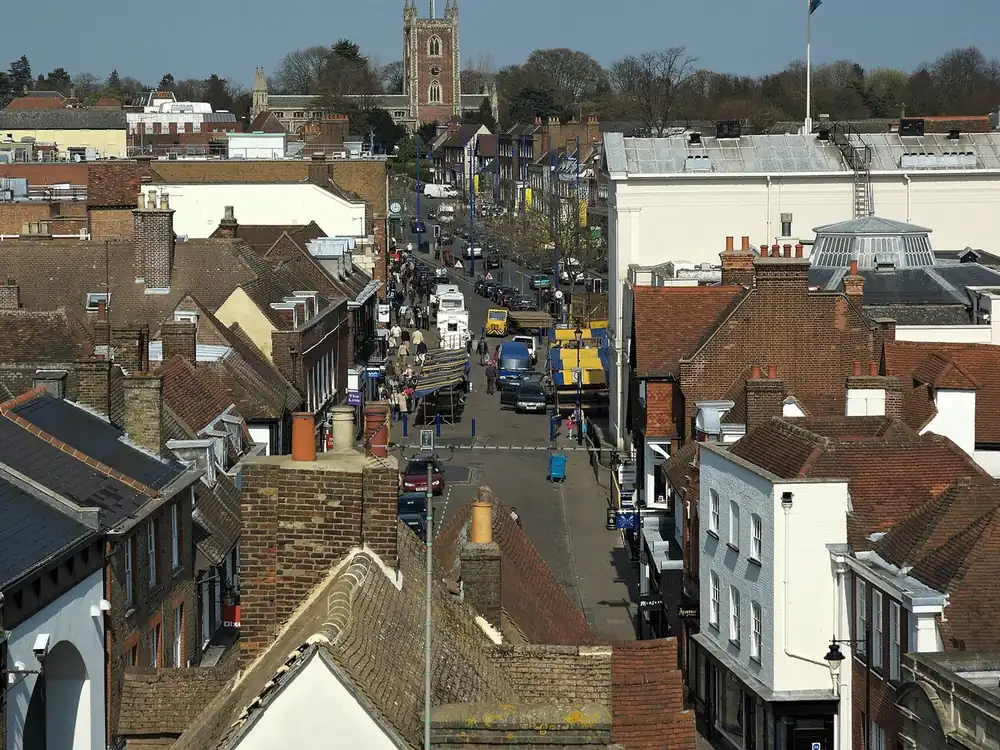
St Albans city centre, seen from the Clock Tower. The St Albans war memorial stands in front of St Peter's Church, in St Peter's Street.
Photo: Gary Houston, CC0.
Other memorials of the same years
St Albans has around 40 First World War memorials. Alongside the city cross, three stand out:
- A roll of 635 names, unveiled in November 1920 in the town hall and now in the Council Chamber of the Civic Centre.
- The Hertfordshire Yeomanry memorial, erected in July 1921.
- The St Albans School memorial, outside the school entrance near the Cathedral, unveiled on 16 February 1925. It commemorates 87 old boys killed in the First World War.
And then there were the streets, which made their own memorials. That story comes next.
Keep reading
Previous: ← The Fallen: The People Behind the Names
Next: The Street Memorials of the Abbey Parish →
📖 Read the whole illustrated book. Turn the pages like a real book, or swipe on your phone.
All 13 parts
- Introduction: Why We Remember
- August 1914: Two Towns Go to War
- Harpenden in the Great War: Camp, Hospital and Home Front
- St Albans in the Great War: A Garrison Town
- The Fallen: The People Behind the Names
- Building Memory: The Memorials of 1920 and 1921 (you are here)
- The Street Memorials of the Abbey Parish
- Private Edward Warner VC: The Straw Hat Maker from Cannon Street
- Between the Wars: Learning the Ritual
- 1939 to 1945: Harpenden at War
- 1939 to 1945: St Albans at War
- Adding the Second World War Names
- Remembrance Today: Services and Walks
From you, for your neighbours
Share your story
Have a story from your street, your family or your town? Write it up and share it with us, and we'll publish it for your neighbours. It's free, and you don't need to be a writer.
- Local history
- Family and street memories
- Places and walks
- People and profiles
- Food, drink and traditions
- Old photos and keepsakes
A good story usually has
- A clear title
- Your own words
- Which town
- Names and dates, if you have them
- Photos you own or can share