Loading...
Lest We Forget, part 2: August 1914: Two Towns Go to War
Within days of the declaration of war, Harpenden and St Albans stopped being quiet Hertfordshire towns and became part of the military machine.
Part 2 of 13 of Lest We Forget, a history of remembrance in Harpenden and St Albans. Read the whole illustrated book.
Within days of the declaration of war, Harpenden and St Albans stopped being quiet Hertfordshire towns and became part of the military machine.
On 8 August 1914, Parliament passed the Defence of the Realm Act, giving the government power to requisition buildings and land needed for the war effort. In St Albans, billeting officers moved quickly. Schools, civic buildings, church halls, hotels, factories and parks were taken over, along with rooms in private homes ranging from small cottages to large Edwardian villas. Around 7,000 soldiers descended on the city.
One of them was Rifleman Patrick MacGill, who later wrote a memoir of his time there. He described being dropped among the people of a city sleeping in the shadow of an ancient cathedral, and said that was the moment he felt he was a soldier. Billeting could be uncomfortable for everyone. Soldiers sleeping on the schoolroom floor of Dagnall Street Baptist Church were reported in the Herts Advertiser that October as feeling the effects of their inoculations. Householders were paid to feed and house the men, with rations delivered to the door in a wheelbarrow of meat, bread, potatoes, sugar, tea, cheese and jam.
St Albans as a war station
St Albans had a military role even before the war began. The city was home to 'C' Squadron of the Hertfordshire Yeomanry, 'B' Company of the 1st Battalion, Hertfordshire Regiment, the 1st Hertfordshire Battery of the Royal Field Artillery, and part of an ammunition column. These were Territorial units, part-time volunteers sometimes called Saturday Night Soldiers, who drilled in their spare time.
When war came, they were mobilised. Under the War Office's home defence plans, the St Albans Territorials moved to Essex and East Anglia to guard against a possible German invasion. They were replaced in the city by units of the 2nd London Division, which used St Albans as its war station, and later by other divisions.
The Territorials did not stay at home for long. With reinforcements urgently needed in France, the War Office asked them to volunteer for overseas service, and most of Hertfordshire's Territorials agreed. The 1/1st Hertfordshire Regiment landed at Le Havre in November 1914 and was in action in the Ypres Salient that same month. Others went on to Gallipoli and the Middle East, fighting a war very unlike the one they had imagined when they signed up in peacetime.
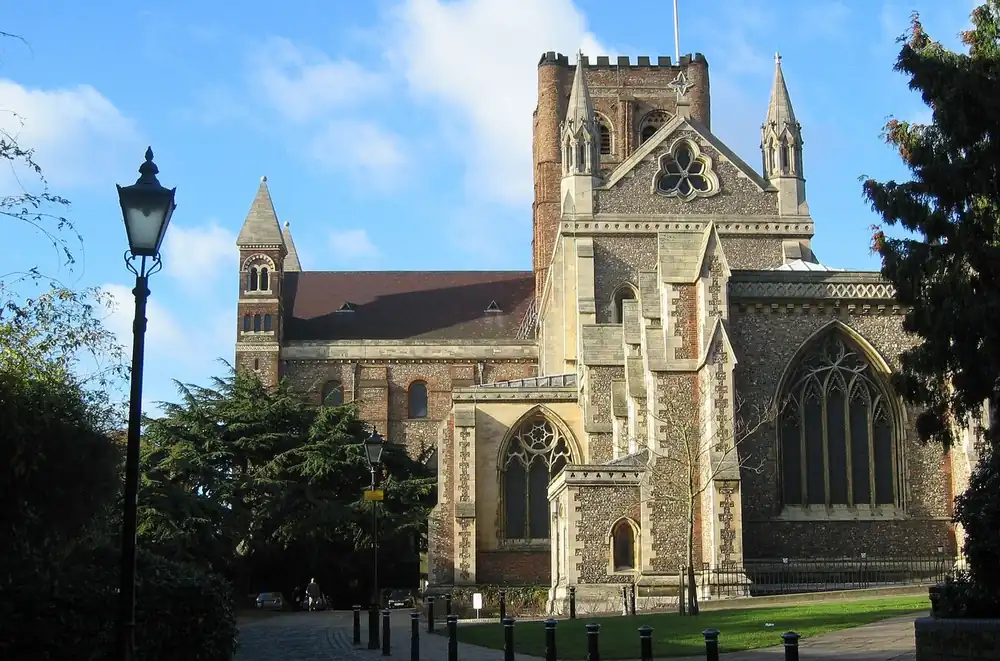
St Albans Cathedral, whose clergy dedicated eighteen temporary street shrines in 1916 and 1917.
Photo: Gary Houston, CC0.
Harpenden: a village of 6,000 hosts 4,000 soldiers
Harpenden's experience was just as sudden. Four battalions of the Notts and Derbyshire Regiment, some 4,000 men, arrived in August 1914 and were billeted in houses across the village. At the time Harpenden's population was only about 6,000, so for a time nearly two in every five people on the streets were soldiers.
The soldiers marched, trenched and trained on the Common and in Rothamsted Park, and attended church parades there. The village adapted in every way it could: families took men in, local women organised first aid courses and, as the next section describes, the town built its own military hospital from nothing.
By the end of that autumn, both towns had absorbed the first shock. Neither yet knew how long the war would last, or how many of the men they were feeding and housing would never come home.
Keep reading
Previous: ← Introduction: Why We Remember
Next: Harpenden in the Great War: Camp, Hospital and Home Front →
📖 Read the whole illustrated book. Turn the pages like a real book, or swipe on your phone.
All 13 parts
- Introduction: Why We Remember
- August 1914: Two Towns Go to War (you are here)
- Harpenden in the Great War: Camp, Hospital and Home Front
- St Albans in the Great War: A Garrison Town
- The Fallen: The People Behind the Names
- Building Memory: The Memorials of 1920 and 1921
- The Street Memorials of the Abbey Parish
- Private Edward Warner VC: The Straw Hat Maker from Cannon Street
- Between the Wars: Learning the Ritual
- 1939 to 1945: Harpenden at War
- 1939 to 1945: St Albans at War
- Adding the Second World War Names
- Remembrance Today: Services and Walks
From you, for your neighbours
Share your story
Have a story from your street, your family or your town? Write it up and share it with us, and we'll publish it for your neighbours. It's free, and you don't need to be a writer.
- Local history
- Family and street memories
- Places and walks
- People and profiles
- Food, drink and traditions
- Old photos and keepsakes
A good story usually has
- A clear title
- Your own words
- Which town
- Names and dates, if you have them
- Photos you own or can share