Loading...
Lest We Forget, part 10: 1939 to 1945: Harpenden at War
Harpenden was lucky in the Second World War, but luck is not the same as being untouched. The town was ringed by targets such as the factories at Luton and Hatfield, and it spent six years preparing for the worst, sheltering children from London and sending its own young people to war.
Part 10 of 13 of Lest We Forget, a history of remembrance in Harpenden and St Albans. Read the whole illustrated book.
Harpenden was lucky in the Second World War, but luck is not the same as being untouched. The town was ringed by targets such as the factories at Luton and Hatfield, and it spent six years preparing for the worst, sheltering children from London and sending its own young people to war.
Wartime Harpenden at a glance
- High-explosive bombs on the area 41
- Incendiary bombs on the area 2,099
- Houses with minor damage About 180
- Houses badly damaged One, at 10 Crabtree Lane (20 October 1940)
- Child evacuees Between 1,500 and 2,000, depending on the source
- Capacity of the concrete trenches on the 400 people Common
- Last air raid alert 29 March 1945
- Second World War names on the memorial About 110
Before the war: gas masks and shelters
The preparations began in 1938. A specimen air raid shelter was dug in Stewart Road for residents to visit and copy in their own gardens. On 23 September, 20,000 gas masks were delivered to the Old Public Hall. By May 1939 a new control room for air raid precautions and the fire brigade had been built six feet underground behind the fire station in Leyton Road.
Concrete-lined trenches with seating and electric lighting were completed on the Common near Heath Road in November 1939. More shelters went under the car park behind the Public Hall, under Leyton Green and under the green in front of Bowers Parade. The Women's Voluntary Service was set up on 27 January 1939 and ran tea rooms for soldiers, food schemes and camouflage-net making.
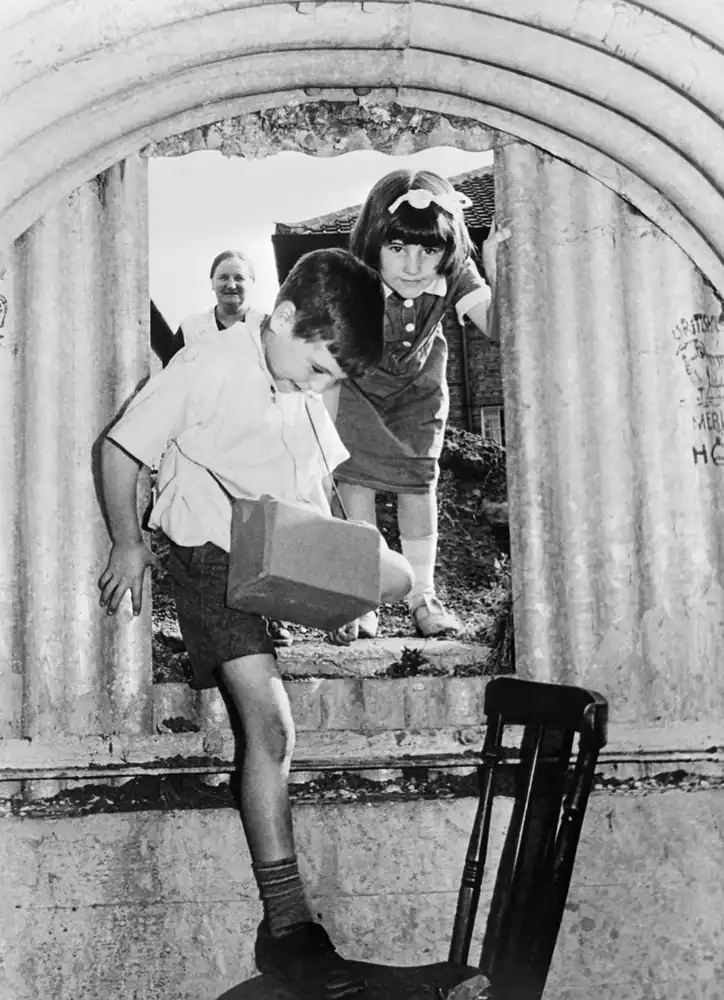
Illustrative: a boy entering an Anderson shelter in a garden in Eltham, London, in the summer of 1940.
Photo: Ministry of Information Photo Division, Imperial War Museums (D 778). Public domain.
Evacuees, the Home Guard and the town's war work
When war began, Harpenden had to find homes for child evacuees from London. Some arrived on the first two days, more followed, and local families and a hostel for evacuee boys on Hollybush Lane took them in. One evacuee later described arriving from Enfield on the day war was declared. Another group came from Hastings in July 1940 because of the threat of invasion on the south coast. In both cases, children were fed at a reception point before being taken to their billets.
The Local Defence Volunteers, later the Home Guard, formed in May 1940, and Harpenden was proud of how quickly it happened. The call went out on a Tuesday, and minutes later the first volunteers were signing on at the police station. By the following Saturday armed patrols were out.
Much of Harpenden's ordinary life was reorganised around the war. The government requisitioned empty property, garages and halls for storage and soldiers' tea rooms, some run by the Salvation Army. Insurance companies and other businesses moved out of London into empty shops and houses, including the Westminster Fire Office, which took several shops in Bowers Parade. A secret listening post was set up at Rothamsted Manor, a prisoner of war camp was built at Batford, and the Land Army ploughed up the Common to grow vegetables. Railings and aluminium saucepans were collected for scrap, and the Air Training Corps trained 237 men between 1941 and 1946.
Bombs, balloons and aircraft overhead
The worst night came on 20 October 1940, when a bomb hit 10 Crabtree Lane. A woman and child who had taken shelter under the stairs escaped injury. A boy who lived there later said he owed his life to his mother's decision to sleep under the stairs after an earlier landmine had blown out the windows. On Sunday 12 May 1941, a series of incendiary bombs burnt out the roof of Batford Methodist Church. A disaster was averted when one fire bomb fell into a wood yard in Cowper Road.
Residents remembered the air war in vivid detail. One recalled watching German aircraft heading for the Vauxhall works at Luton on 30 August 1940, and seeing a parachute that belonged to the pilot of a shot-down Hurricane. Another remembered a barrage balloon that broke from its mooring and was shot down onto the Common by a Spitfire.
Supporting those who served
The local newspaper, the Harpenden Free Press, stopped publishing during the war, so many personal details have been lost. In 1943, the Comforts Fund Committee produced a small news-sheet, Echoes from Harpenden, and sent it to every Harpenden man and woman in the forces. It carried news of "our boys", descriptions of the village through the seasons, and Red Cross and council news. In August 1944, a week of entertainments, including a funfair, boxing, a grand ball and a brains trust, raised £2,122, more than double its £1,000 target.
Kenneth Lockhart was the first Harpenden officer killed in the war. Sergeant Basil Friendship of Church Green was the first local man to be decorated, receiving the Distinguished Flying Medal and Bar.
Victory and the long wait
Harpenden's last air raid alert came at 8.45am on 29 March 1945, with the all-clear sounding seven minutes later. When the end of the war was declared on 8 May, schools closed and church bells rang. A service was held at the parish church, and those who could not get in listened to the King and Churchill over loudspeakers outside. Bonfires were lit across the town, and from the prisoner of war camp at Batford, rockets lit the sky in different colours. The council held a celebration party in the Public Hall on 10 May.
Peace brought a long wait for forces personnel to come home. Some of the prisoners at Batford chose to stay in Harpenden. Gradually people picked up their pre-war lives, and the town's identity returned, the local history society records, when the Harpenden sign on the Common was put back, having been removed for the duration. The names of those who fell were added to the memorial on Church Green, where recast plaques were unveiled on 6 November 1949.
Keep reading
Previous: ← Between the Wars: Learning the Ritual
Next: 1939 to 1945: St Albans at War →
📖 Read the whole illustrated book. Turn the pages like a real book, or swipe on your phone.
All 13 parts
- Introduction: Why We Remember
- August 1914: Two Towns Go to War
- Harpenden in the Great War: Camp, Hospital and Home Front
- St Albans in the Great War: A Garrison Town
- The Fallen: The People Behind the Names
- Building Memory: The Memorials of 1920 and 1921
- The Street Memorials of the Abbey Parish
- Private Edward Warner VC: The Straw Hat Maker from Cannon Street
- Between the Wars: Learning the Ritual
- 1939 to 1945: Harpenden at War (you are here)
- 1939 to 1945: St Albans at War
- Adding the Second World War Names
- Remembrance Today: Services and Walks
From you, for your neighbours
Share your story
Have a story from your street, your family or your town? Write it up and share it with us, and we'll publish it for your neighbours. It's free, and you don't need to be a writer.
- Local history
- Family and street memories
- Places and walks
- People and profiles
- Food, drink and traditions
- Old photos and keepsakes
A good story usually has
- A clear title
- Your own words
- Which town
- Names and dates, if you have them
- Photos you own or can share