Loading...
Lest We Forget, part 1: Introduction: Why We Remember
Every November, Harpenden and St Albans stop for two minutes. The parades, wreaths and poppies are so familiar that they can feel like they have always been part of British life, but they are barely a century old, and the way our two towns built them is a story in its own right.
Part 1 of 13 of Lest We Forget, a history of remembrance in Harpenden and St Albans. Read the whole illustrated book.
Every November, Harpenden and St Albans stop for two minutes. The parades, wreaths and poppies are so familiar that they can feel like they have always been part of British life, but they are barely a century old, and the way our two towns built them is a story in its own right.
This history follows that story from August 1914 to the present. It covers the soldiers who arrived in both towns at the outbreak of war, the people left at home, the memorials built in 1920 and 1921, and the second war that added hundreds of new names. It draws on local history societies, museum collections and public records, and it names real people wherever the sources allow.
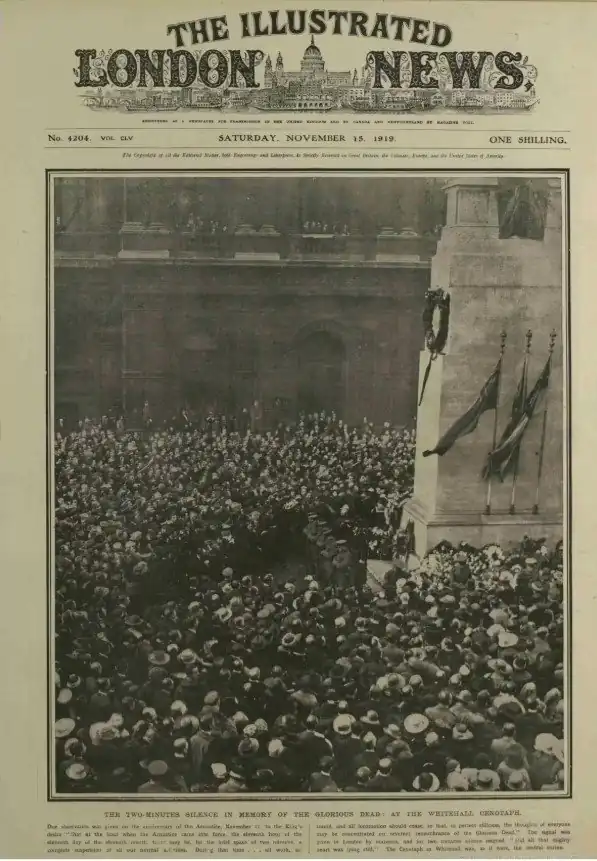
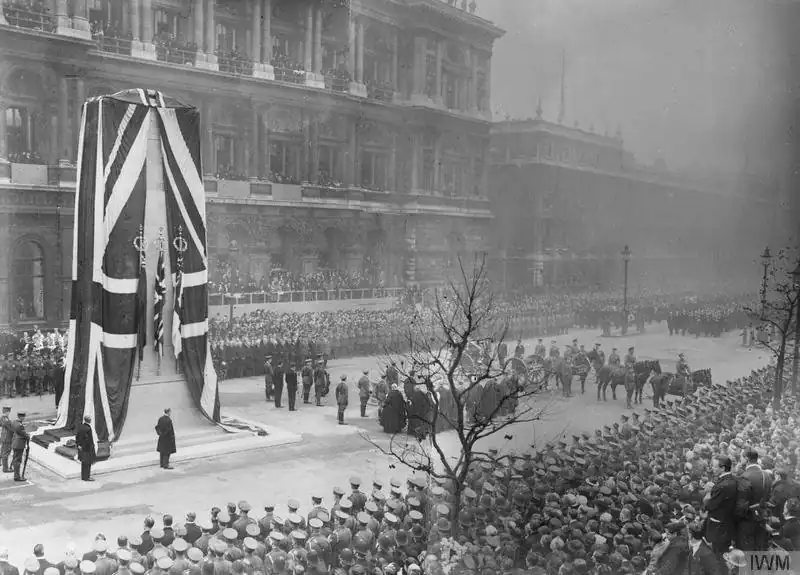
Left: crowds at the Cenotaph in Whitehall, from The Illustrated London News, 1919. Right: the Cenotaph in 1920, the year the permanent memorial was unveiled.
Photos: The Illustrated London News, 1919. Public domain. | Horace Nicholls, Imperial War Museums (Q 31513). Public domain.
How the nation learned to remember
The rituals we now take for granted were invented in a hurry between 1919 and 1921, by a country that had lost almost a generation and had no precedent for mourning on that scale.
The two-minute silence began on the first anniversary of the Armistice. King George V issued a letter on 7 November 1919 calling for the nation to pause at 11am, the hour at which fighting had largely ended in 1918. The following year, on 11 November 1920, the permanent Cenotaph on Whitehall was unveiled, designed by Sir Edwin Lutyens. The same day, the body of an unidentified British serviceman, the Unknown Warrior, was buried in Westminster Abbey.
The poppy came next. The image began with John McCrae's 1915 poem "In Flanders Fields", and was promoted after the war by the American academic Moina Michael and the French campaigner Anna Guérin. Guérin persuaded Field Marshal Douglas Haig, founder of the British Legion, to adopt it. The Legion was formed on 15 May 1921, and its first Poppy Appeal on 11 November 1921 sold out, raising about £106,000. In 1922, Major George Howson founded the Poppy Factory to employ disabled ex-servicemen to make them.
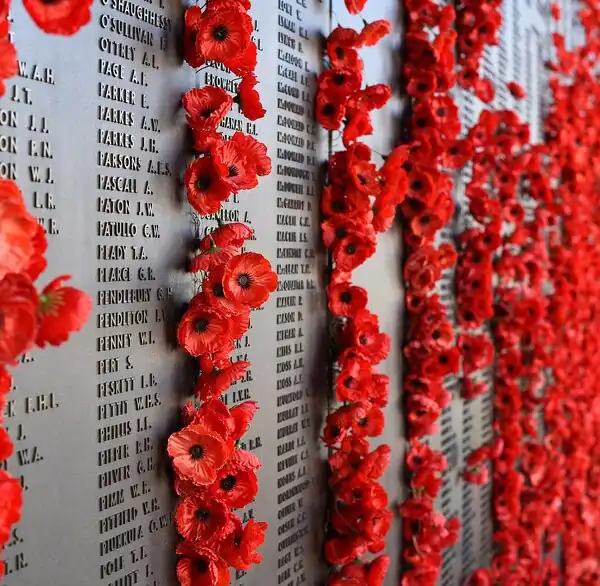
Remembrance poppies beside the names on a memorial wall.
Photo: Gerard Dutton, CC0 (Wikimedia Commons).
After the Second World War, the commemoration changed once more. In 1946 the second Sunday in November was named Remembrance Sunday, so that one ceremony could honour the dead of both world wars. That is why Harpenden and St Albans hold their services this Sunday, 8 November 2026, rather than on 11 November itself.
What this history covers
- How both towns became military camps in August 1914
- What happened to the people left at home
- The memorials of 1920 and 1921, and the street plaques unique to St Albans
- The story of Private Edward Warner VC
- The Second World War on the home front
- How to take part in Remembrance today, and where to walk to see the memorials for yourself
Keep reading
Next: August 1914: Two Towns Go to War →
📖 Read the whole illustrated book. Turn the pages like a real book, or swipe on your phone.
All 13 parts
- Introduction: Why We Remember (you are here)
- August 1914: Two Towns Go to War
- Harpenden in the Great War: Camp, Hospital and Home Front
- St Albans in the Great War: A Garrison Town
- The Fallen: The People Behind the Names
- Building Memory: The Memorials of 1920 and 1921
- The Street Memorials of the Abbey Parish
- Private Edward Warner VC: The Straw Hat Maker from Cannon Street
- Between the Wars: Learning the Ritual
- 1939 to 1945: Harpenden at War
- 1939 to 1945: St Albans at War
- Adding the Second World War Names
- Remembrance Today: Services and Walks
From you, for your neighbours
Share your story
Have a story from your street, your family or your town? Write it up and share it with us, and we'll publish it for your neighbours. It's free, and you don't need to be a writer.
- Local history
- Family and street memories
- Places and walks
- People and profiles
- Food, drink and traditions
- Old photos and keepsakes
A good story usually has
- A clear title
- Your own words
- Which town
- Names and dates, if you have them
- Photos you own or can share